|
| Full text of William Neill's article |
 |
Gaelic in the Galloway News 1983
|
This the paper I will read on the shift from Gaelic to Scots in Galloway at the 'Galloway: Gaelic's Lost Province?' conference Saturday 8 September 2018.
In
1972, I had the opportunity to learn Gaelic at Castle Douglas High
School. The class was taught by William Neill who was a teacher at
the school as well as being a Gaelic poet and scholar. Mr Neill, as I
still think of him, had been born in Prestwick in 1922. As a teenager
he would visit the harbour at Ayr where he was fascinated to hear
Gaelic being spoken by fishermen from the Western Isles which
inspired him to learn their language.
Although
I failed to learn very much Gaelic from William Neill, I recall him
telling us that Gaelic was still spoken in Galloway in the time of
Mary, Queen of Scots. In article he wrote for the Galloway News in
1983 about Gaelic farm names he said “Before 1560, the whole of
the south-west was solidly Gaelic speaking according to modern
scholarship.” 1560 is a date associated with the Reformation in
Scotland suggesting that William Neill saw the Reformation as
bringing about the transition from Gaelic to Scots in Galloway. This
afternoon I will argue that the Reformation came towards the end of
the transition from Gaelic to Scots in Galloway not its beginning.
The
Galloway News article shows Mr Neill standing in front of the sign
for Drumskelly, one of several farms with Gaelic names in
Crossmichael parish. Before 1560, the farms in Crossmichael parish
belonged to Lincluden collegiate church.
A
rental roll for Lincluden in 1557 lists the farms owned and their
tenants. Among the farms listed are Hillowton and Gerranton, both
near Castle Douglas. Michael Hillow was a tenant of Hillowtown and
John and Ninane Garrane were tenants in Gerranton. Chapmanton is
also listed, but there were no Chapmans living there. Along with
Blackpark, these are all Scots farm names which show that in
Crossmichael parish at least, the people had ceased to be solidly
Gaelic speaking sometime before 1560.
In
neighbouring Kelton parish a list of farms compiled in 1456 includes
two farms with Scots names- Carlingwark and Whitepark. However, the
same list shows that next to Whitepark but in Buittle parish were the
farms of Cuil and Corra, both Gaelic farm names. In 1324 king Robert
I granted Buittle to James Douglas and the charter describes the
boundaries of Buittle. Torrs in Kelton is mentioned but not Whitepark
nor Cuil and Corra which were then still part of a large farm now
called Breoch.
One
of the farms which is mentioned is the Scots Corbieton which belonged
to the Corbett family. Unfortunately
there is no certain date for when the Corbetts acquired Corbieton,
but it is an early indication of the shift towards the Scots
language.
Cuil
and Corra were still not included as separate farms in a Buittle
rental roll from 1375 so must have been formed and given their Gaelic
names sometime between then and 1456. Carlingwark and Whitepark will
have been given their Scots names in this same period. They were part
of the arable grange lands attached to Threave castle which was
constructed for Archibald the Grim after he gained control of eastern
Galloway in 1369 and bought western Galloway from Thomas Fleming,
earl of Wigtown for £500 in 1372.
Archibald,
like his father James Douglas, was a Bruce loyalist. His task was to
rein in the Gaelic kindreds of Galloway who had supported Edward
Balliol against Robert the Bruce's son king David II. Archibald's
success is shown on his seal where two 'wild men of Galloway' support
his coat of arms.
 |
| Two wild men of Galloway tamed by Archibald the Grim |
What
did Douglas rule mean for the leading Gaelic families of Galloway?
For
Sir John McCulloch of Mochrum parish it meant losing his lands to a
Scot from Midlothian. At Lincluden in September 1414, McCulloch
resigned his lands to Archibald, 4th earl of Douglas, lord of
Galloway and Annandale and son of Archibald the Grim. In October
1414, Archibald directed Uhtred McDowall, sheriff of Wigtown to
transfer McCulloch's lands to William Hay of Locharwart, which is in
Midlothian.
But
in 1418, Hay complained to Archibald that he 'could nocht gett payt
his mailis ' due to the 'etting his lands', which as a result were
'skaithit', that is harmed. Archibald responded by instructing Robert
Crichton of Sanquhar and his 'fellow Mcgyewe' , who were his officers
on the west side of the Cree to 'distress' those responsible until
they fully amended their fault. John McCulloch is the person most
likely to be responsible for the etting and so would have been
'distressed' by Archibald's officers.
The
Scots language of these and other documents show that the
administration of Galloway was conducted in Scots throughout the
period of Douglas rule until it ended in 1455. Despite this use of
Scots we have evidence that Gaelic survived.
Evidence
that Gaelic survived the period of Douglas rule comes from two
sources. From 1487 there is a complaint that John Brown, the Scots
speaking vicar of Kirkcolm 'does not understand and cannot speak
intelligibly the language (that is Gaelic) of the place in which it
is situate, to the detriment of souls…'
The
second source is research by John Bannerman and others which revealed
the existence of at least three generations of clarsach players in
Wigtownshire between 1471 and 1513. The last of these was Roland or
Lachlann McBratney who played for king James IV and may also have
been employed by the prior of Whithorn. In one of the royal
treasurer's accounts of payments to Lachlann, he is described as an
Irish, that is Gaelic, harper. In another from 1503, he was paid 5
crowns for a journey to 'the isles'.
Significantly,
another branch of his family were renowned harpists living on Gigha
and Bannerman speculates that Lachlann visited them in 1503. It has
even been suggested that the Gigha branch of the family originally
came from Galloway via the Priory of Whithorn's lands in south
Kintyre. But although Gigha was part of a cultural network which
linked Gaelic Scotland and Ireland in the fifteenth century, Galloway
under its Scots speaking Douglas lords had not been part of this
network.
As
an aside, while researching the McBratneys, I discovered that there
are still McBratneys living in Whithorn and was able to pass on my
findings to Alexander McBratney from Whithorn who is now professor
of soil science at the University of Sydney.
Then,
during the later fifteenth century, Galloway became even more
Scottish. A major influence on the shift from Gaelic to
Scots in Galloway were the burghs of Dumfries, Kirkcudbright, Wigtown
and Whithorn. In the far west there was also Innermessan until it was
supplanted by Stranraer in the seventeenth century.
Part
of the burghs' importance are their locations. Kirkcudbright
lies at the southern end of a broad strip of good quality farm land
stretching from the Fleet to the Nith at Dumfries. A smaller strip of
good quality land lies along the coast between Kirkcudbright and
Dumfries.
In
1755, even before the towns of Gatehouse, Castle Douglas and
Dalbeattie had been established, 70% of the population of the
Stewartry lived in this lowland area which was predominantly an
arable farming district.
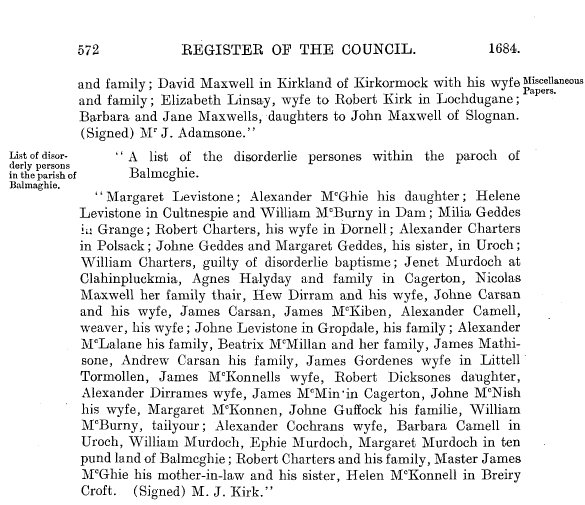
In
1684 parish lists of all the inhabitants of Wigtownshire and
Minnigaff over the age of 12 were compiled. The lists give the number
of occupants of over 650 farms as well as the burghs and the village
of Minnigaff. Even for the overwhelmingly upland parish of Minnigaff,
54% of the population lived in Minnigaff village and farms on the
fertile carse land beside the Cree.
In
Wigtownshire, only 10% of the population lived in farms on poorer
quality land, spread across the upper parts of Inch, New Luce,
Kirkcowan and Penninghame parishes. 40% of the Wigtownshire
population lived in the Machars which included the burghs of Wigtown
and Whithorn. Although these burghs only accounted for 7% of the total
Wigtownshire population, 19% of the population of the Machars lived
in them.
The
Wigtown Burgh Court books survive for the years 1513 to 1534. They
are written in Scots and have been analysed by linguist Joanna
Kopakzyk who concluded that the language used was typical of the
Scots written and spoken across Lowland Scotland in the sixteenth
century. She also noted that ‘the Burgh Court Book has no passages
written in Gaelic or translated into or from Gaelic. There is no
mention of interpreters needed for trials or for documents, therefore
one may infer that Scots was a well established means of
communication in the burgh.’
If
Scots was already established in Wigtown by 1513, how far did that
influence extend? Researching the place names of Wigtowsnhire, John
McQueen found that farms recorded in Penninghame parish with the
Scots names Meikle and Little Elrik in 1506 were then recorded with
the Gaelic names Heilrikmore and Neilrikbeg in 1507. This suggests
that Gaelic as well as Scots was spoken in the area at this time.
The
farms are 9 miles north west of Wigtown. If Gaelic was still spoken
in upper Penninghame in 1507, it must have been in retreat since
their Gaelic names were not used again and it is as Meikle and Little
Eldrig that the farms became known.
Significantly,
a circle with a radius of 9 miles centred on Wigtown takes in most of
the Machars as well as the more fertile parts of Penninghame and
Kirkcowan. When the burgh of Whithorn and its immediate area is
included, then by the beginning of the sixteenth century, the Scots
language was well established in the Machars.
On
the other hand, we know that Gaelic was still the main language of
the Rhinns in 1487. In 1684, the Rhinns accounted for 29% of
Wigtownshire's population. Before the creation of Stranraer in 1595
the nearest burgh to the Rhinns was Innermessan in Inch parish.
However, Innermesan was a very small burgh so its linguistic
influence would have been limitedm slowing the advance of Scots into
the Rhinns.
However,
an indication that the market economy was expanding into the west of
Galloway comes from 1495 when the village of Ballinclach, now
Glenluce, became a burgh of barony with a weekly market.
In
the Stewartry, the size and importance of Dumfries is likely to have
made Scots the dominant language east of the Urr many years before
1500. Much closer in size to Wigtown than Dumfries, Kirkcudbright's
Scots footprint would have covered the area between the Fleet and the
Urr and stretched up to the edge of the Glenkens. As a consequence of
the combined influence of Dumfries and Kirkcudbright, by 1500 70% of
the population of the Stewartry were potentially Scots speakers.
If
the balance between Gaelic and Scots use had begun to shift in favour
of Scots between 1455 and 1500, what happened over the next 60
years? Written evidence for the use of Scots increases since more
legal documents and letters survive. For example, in the protocol
book of notary Herbert Anderson, dated 23 May 1541, Alexander Gordon
of Airds in the Glenkens made a declaration in Scots concerning the
disposal of the estate of the deceased Ninian Glendinning of Parton.
Perhaps,
as a non-native family, the Gordons of the Glenkens had never been
Gaelic speakers, but the family of Thomas McDowall of Glenluce
certainly had been. In 1556, Thomas represented his grandmother Janet
McDowall at the Baron Court of Glenluce where she was accused of
passing on her tenancy of Sinniness farm to another person without
permission. The case lasted several days and the record of the
proceedings shows it was conducted in Scots.
Although
Janet McDowall could have grown up in a Gaelic speaking household,
her grandson was a fluent Scots speaker able to hold his own in the
baron court and get the case transferred to Edinburgh. Yet as the
grandson of a tenant farmer, he was of low social status. Could
Thomas McDowall have spoken Gaelic as well as Scots? Unfortunately
it is impossible to tell from the evidence available. What we do know
is that the Scots language in Galloway was soon to get a powerful
ally- the Reformed Church.
Alexander
Gordon of Airds is reputed to have pioneered the Reformation Galloway
in the 1530s when he secretly read from an English translation of the
bible to his family and his tenants in Airds wood. However, this was
an essentially private affair, very different from the national
Reformation which began in 1560.
The
Reformation in Scotland was deeply influenced by Calvinism. Robert
Kingdon has described Calvinism as
a
serious attempt to control human behaviour in all its variety. It
meant that the church had a responsibility not only to present true
Christian doctrine but also to shape true Christian behaviour. And
this responsibility, Calvinists believed, could not be left to
individuals or to governments. It had to be assumed, to as great a
degree as possible, by the church… which became a remarkably
intrusive institution, penetrating every aspect of life.
In
other words, the new Calvinist faith was about much more than simply
requiring the faithful to attend church on Sunday. It also sought to
extend its influence into the home, to shape and influence family
life. Men, women and children were all expected to have an
understanding of the Christian faith and to be able to demonstrate
that understanding by reciting the key principles of the Reformed
religion.
In
the Highlands and Islands the Reformers had to translate and adapt
their message in order to reach Gaelic speakers. But in Galloway, by
1560 the gradual expansion of Scots outwards from the burghs had made
Scots the majority language. Unfortunately, parish records from
Galloway for the period 1560 to 1640 have not survived. This is
frustrating since it means we don't know if they contained any
references to the survival of Gaelic in the upland districts or in
the Rhinns.
It
is therefore possible that Gaelic may still have been spoken in some
parts of Galloway into the seventeenth century. Indeed, we may even
have evidence that it was.
Dr
Christopher Irvine was an Edinburgh based physician and
historiographer to kings Charles II and James VII and II. He was born
in 1618 at Enniskillen in Ireland where his Scottish father had been
granted lands as part of the Plantation of Ulster. The Irish uprising
of 1641 forced the family to take refuge in Scotland, passing through
Portpatrick in the Rhinns as they fled Ulster. Although his father
and brothers later returned to Ireland, Christopher did not.
In
his book 'Historiæ Scoticæ nomenclatura Latino-vernacula' published
in 1682, Irvine wrote-
Vetustus
Sermo : the old language of our ancestors, the Galick Albanich, the
Highland galick, which at this day is spoken in all our Hilly
Countries and Isles, and in my time was spoke much in the Rinns of
Galloway.
What
Irvine seems to be saying is Gaelic was still present in the Rhinns
in 1641 when he heard it spoken. However, unlike in the 'hilly
countries and isles', by 1682 Gaelic was no longer spoken in the
Rhinns.
If
Irvine's statement does mean that Gaelic was no longer spoken in the
Rhinns by 1682, this accords with Andrew Symson's 'Large Description
of Galloway'. Symson was minister of Kirkinner parish in the Machars
for over 20 years during which time he acted as secretary to the
Synod of Galloway. This gave him a good knowledge of Galloway and
makes the Large Description, which began compiling in 1684, a very
comprehensive document It includes, for example, a discussion of the
Scots dialect spoken by the 'country people'. However, Symson does
not make any reference to the survival of Gaelic in the Rhinns- nor
anywhere else in Galloway.
Christopher
Irvine spent only a short time in the Rhinns, unlike the Reverend
John Livingston, who my family claim as an ancestor. Livingston
first visited Galloway in 1626 at the invitation of John Gordon of
Kenmure, the founder of New Galloway. In 1630 Livingston became
minister of Killinchy in County Down before crossing back to Galloway
where he became minister of Stranraer parish in 1638. In an account
of his life, Livingston says that he chose Stranraer because its
proximity to Portpatrick allowed him to keep in touch with his former
parishioners. He also mentions the Irish uprising which broke out in
the autumn of 1641.
The
winter following many came fleeing over to Scotland, sundry to Ayr
and Irvine, and other places of the west, by sea; but the greatest
number came by Portpatrick and Stranraer, and were generally in a
very destitute condition.
In
Stranraer, Livingston was a very active minister, leading daily
prayer sessions in his church. He had been brought up in Lanarkshire
and was not a Gaelic speaker. However, unlike John Brown of Kirkcolm
in 1487, Livingston experienced no difficulties communicating with
his parishioners nor those of neighbouring parishes when he attended
communion.
During
my abode in Stranraer, the neighbouring ministers with whom I kept
most society, were my brother M‘Clellan at Kirkcudbright, Robert
Hamilton at Ballantrae, George Hutchison at Colmonell, Alexander
Turnbull at Kirkmaiden in the Rhinns, John Dick at Inch, George Dick
at Glenluce,Andrew Lander at Whithorn, and John Park at Mochrum. With
all these I have been at their communions, and most of them have been
at communions with us at Stranraer.
This
creates a problem. If Gaelic was still 'spoke much' in the Rhinns 'in
my time' as Irvine claimed, why did Livingston not mention this fact?
A
possible answer is that the Gaelic Irvine heard was restricted to the
ferry boatmen who crossed between Donaghadee and Portpatrick. The
ferry service was established after James Hamilton and Hugh
Montgomery began the Scottish plantation of Ulster in 1606. On the
Irish side, where there were 16 passage boats by 1617, the crews must
have been drawn from the Irish population of County Down since even
by 1630 there were only 2000 adult male settlers from Scotland
scattered across the county. The Plantation did not remove Irish
speakers and there were still 984 Irish speakers living around
Donaghadee in 1659.
Remote
from the influence of Scots speaking burghs and only 21 miles across
the North Channel from Irish speakers, there were probably still
Gaelic speakers in the Rhinns before the Plantation in 1606. If the
Donaghadee passage boats were crewed by Irish sailors, frequent
contact with them could therefore have sparked a minor Gaelic revival
in the Rhinns, centred on Portpatrick.
However,
this revival is unlikely to have survived Irish uprising of 1641.
Although 12 000 Scots and English settlers were killed in the
uprising, exaggerated accounts soon circulated claiming that as many
as 150 000 Protestant settlers had been massacred by Irish Catholics.
Some of the refugees who fled to Scotland were Irish. Six reached
Kirkcudbright where they were arrested and sent to England. It was
not a good time to be Irish in Scotland.
To
protect the Scottish settlers, a Scottish army was despatched to
Ulster. John Livingston was with this army as a chaplain in April
1642.
I
went with the army to the field, when they took in Newry. A part of
the rebels that made some opposition by the way at the entry of a
wood were killed. They were so fat, that one might have hid his
fingers in the lirks of their breasts.
Only
two years earlier, in the summer of 1640, the Army of the Covenant
had besieged Caerlaverock castle in Nithsdale and Threave castle in
Galloway. The castles were held for Charles I by Robert Maxwell, the
Roman Catholic earl of Nithsdale. Most of the defenders were drawn
from the local Catholic community which had survived the Reformation
under the protection of the Maxwells. Unlike in Ireland, after the
castles had been surrendered, their defenders were allowed to depart
peacefully rather than being slaughtered.
During
1644-45, the campaign of Montrose supported by Irish Confederate
troops led by Alasdair MacColla brought the bitterness of Ulster back
to Scotland. Contemporary Covenanter propaganda focussed on the
'Irish rebels' rather than Montrose and when the tide finally turned
in the Covenanters favour, any Irish soldiers captured were executed
automatically. In July 1645, female Irish camp followers were also
rounded up and killed.
Although
MacColla led the Irish troops, he was born on Colonsay. However, he
was a member of Clan Donald South and cousin to Ranald McDonnell, the
Roman Catholic and Gaelic speaking earl of Antrim. Many of the Irish
Confederate troops MacColla led were from Antrim. Ironically, James
VI and I had intended the Plantation of Ulster to drive a wedge
between the Gaelic communities of western Scotland and north-east
Ireland and bring an end to the military and cultural connections
between these communities.
 |
| Scotland and Ulster as mapped circa 1600 |
If
there had been a significant Gaelic speaking population in Galloway
in the 1640s, particularly in the Rhinns, they would have figured in
the political and military calculations of the time. The Irish would
have seen them as potential allies, the Scots as potential enemies. A
possible Galloway connection did emerge in 1643 when Ranald McDonnell
was captured by the Scottish army in Ulster. Among the letters found
on McDonnell was one showing that he had been seeking support from
Robert Maxwell, earl of Nithsdale.
However,
although a Roman Catholic and a Royalist, neither Maxwell nor
Galloway's
Catholic community were Gaelic speakers. They were treated with
suspicion and hostility, but even when the Synod of Dumfries took
action against 39 named Catholics in 1647, they were excommunicated
rather than being executed. As Scots speakers they were not subject
to the fear and hatred directed against Gaelic speaking Roman
Catholics in Ireland and Scotland.
Thus
leads on to a significant point. Despite 250 years of hostility and
occasional persecution, what had been an important part of Galloway's
medieval culture- its religion- survived into the nineteenth century.
In 1704 there were still 418 Roman Catholics in the eastern
Stewartry and Webster's Census of 1755 recorded 349 Roman Catholics
in the same district.
Religious
continuity was preserved through chapels served by Jesuits which were
maintained by members of the Maxwell family near New Abbey, near
Dumfries and at Munches near Dalbeattie. The chapel at Munches
survived until 1811 when it was transferred to Dalbeattie.
But
while Galloway's old religion survived, its old language did not.
The
National Covenant was passionately embraced in Galloway. A copy
survives from Minnigaff parish where the entire adult male population
of 355 signed it. Minnigaff is one of the upland parishes where
Gaelic is most likely to have survived, but as hostility to the Irish
and their language grew, social pressure would have enforced the
hegemony of Scots as the language of the Covenants.
It
is possible then that the final stage of the shift from Gaelic to
Scots involved a form of collective self-censorship, of a religiously
inspired rejection of Galloway's Gaelic past. By the time Andrew
Symson began compiling his Large Description of Galloway in 1684 he
had been minister of Kirkinner parish in the Machars for 20 years
during which time he acted as secretary to the Synod of Galloway.
This gave him a good knowledge of Galloway and makes the Large
Description, a very comprehensive document. It includes, for
example, a discussion of the Scots dialect spoken by the 'country
people' as well as some Galloway folk history. But Symson makess no
reference to the survival or recent loss of Gaelic and the folk
history recorded does not date back further than 1450s.
Then, a cewntury after Symson, in 1787 Robert Burns' frind Robert Riddell recorded a
tantalising piece of folk history.
The
two snowy years of 1671 and 2 ruined the Gallick speaking tenants of
the upland farms of the South of Scotland who were then replaced by
others speaking only Lowland Scots
James
Hogg also passed on shepherds' tales of an extreme winter, which he
thought was that of 1620. Weather records don't show the winters of
1671 or 2 as expectionally snowy but they do identify 1674 as the
winter when many thousands of sheep died in an area between Peebles,
Selkirk and Eskdale during the 'Thirteen Drifty Days of March'. The
most detailed account by William Napier in 1822 includes a list of
the farms worst affected- Sundhope, Over-Delorian, Phaup and
Over-Cassock- in the central Borders but no suggestion that any of
the farms affected had Gaelic speaking tenants. An investigation of
estate records from the Borders may solve this mystery.
Finally
we come to a number of reports of the survival of Gaelic in Galloway
and Carrick into the eighteenth and even ninteenth centuries.
Investigated by William Lorimer in 1949, these included several 'last
speakers of Gaelic' living variously in Glenapp 1750, Maybole 1760,
Barr 1762, Minnigaff 1775 and here in the Glenkens 1780.
Of
these, the most intruiging is the one from Minnigaff where it is
claimed Alexander Murray, the celebrated linguist, learnt Gaelic from
his aged father. Murray died in 1813 making him potentially the last
native Gaelic speaker in south-west Scotland. Unfortunately, Murray
himself said that after first learning Welsh in 1792, he later taught
himself Gaelic using William Shaw's 'Analysis of the Gaelic Language'
published in 1778, Shaw's 'Gaelic English Dictionary ' published in
1780 and Alexander Stewart's 'Elements of Gaelic Grammar' published
in 1801.
Other
reports investigated by Lorimer, including the Gaelic schoolmaster
recruited for Barr parish school in 1762, turned out to be the
product of the fertile imagination of Robert de Bruce Trotter in his
'Galloway Gossip' books. Even the more plausible reports left open
the possibility that the 'last speakers' may have learned their
Gaelic from Irish or Scottish sources rather than inherited it as
part of continuous tradition. As Mark Twain might have put it,
rumours of Gaelic surviving into the eigthteenth century are greatly
exaggerated.
In
conclusion then, I must disagree with William Neill. Even before
1560, the south-west had ceased to be soldily Gaelic speaking. The
point of the wedge that was to eventually to divide the land of
Galloway from the Gaelic language and the people from their history
can still be seen. It is the imposing 80 foot high castle of Threave,
built for Archibald the Grim. As lord of Galloway, Archibald achieved
what no king of Scotland had managed to do - he tamed its wild men
and women the McDowalls, the McCullochs and the other Gaelic kindreds
- and made an enduring plantation of Scots speakers among them.
At
the same time, the Douglas lordship preserved the territorial
integrity of Galloway and conserved a degree of cultural continuity
with the kingdom founded by Fergus three centuries before. The
deepest link with Galloway's past was the language of its people,
which preceded even Fergus' kingdom. Galloway's Gaelic language
survived the Douglas lordship, but, as the final assimilation of
Galloway by Scotland got underway, by 1500 the Scots language had
already advanced from the burghs into the surrounding countryside.
Even without the assitance of the Reformation, by 1560 Scots was
already so widely spoken that the transition from Gaelic to Scots
would probably have been completed within one or two generations.
But
tragically, in becoming Scots speakers, the people of Galloway had
lost a huge part of their own history. The oldest pieces of folk
history Symson recorded concerned 'the Black Douglass' and Threave
castle. One described the execution of Patrick McClellan of Bombie at
Threave in 1453 and the other that the great iron gun called Mons
Meg had been wrought and made there. The survival in folk history of
these stories, but none from earlier, illustrates the profound
rupture in Galloway's collective memory which the shift from Gaelic
to Scots created.
The
totality of the physical erasure of Galloway's past was brought home
to me when I began researching the Galloway Levellers and discovered
that no traces of the Galloway landscape that they knew have
survived. The process of agricultural improvement- the Lowland
Clearances- had swept away the medieval fermtouns, the cottars and
their crofts - even the fields of rig and furrow that had been
cultivated for centuries were obliterated. Researching the transition
from Gaelic to Scots in Galloway I have found a similar cultural
erasure of Galloway's Gaelic past.
As
we have found today , much of Galloway's forgotten Gaelic heritage
has been recovered. But sadly, this knowledge has yet to become part
of our collective awareness. As a consequence, the people of Galloway
still lack consciousness of their own history.
However,
rather then end on a downbeat note I will attempt some optimism.
There is a campaign to make Galloway a national park. Part of the
campaign involves arguing that there is an overlap between the
geographical and geological boundaries of Galloway and Carrick and
the area's natural heritage. Equal weight is also being given to the
historical coherence of the area's cultural heritage.
 |
| The Kingdom of Galloway restored |
If
the the national park proposal suceeds we will no longer be able to
describe Galloway as Gaelic's Lost Province. In recognition of the
region's cultural heritage the proposed full title of the new park
will be 'The Kingdom of Galloway National Park'.
I
asked about the inclusion of Kingdom in the title at the National
Park Association's recent agm, where I was assured by the
Association's Chair Dame Barbara Kelly that it had been been
approved by no less an authority than Professor Ted Cowan.
Thanks
to the Gaelic (Scotland) Act of 2005, the Park's name will be present
in Gaelic as well as English on all its signs and logos. Galloway's
first kingdom was a Gaelic speaking kingdom. If Galloway becomes a
kingdom once again, then our Gaelic heritage will become very
publically part of our future as well as our past.